
Indoor smart gardens are designed to remove guesswork from plant care, but the performance of the entire system ultimately depends on two small but critical components: the wick and the float. If you are researching Click & Grow replacement wicks and floats, the clear technical answer is this: wicks regulate root zone moisture through Capillary Precision Irrigation (CPI), while floats monitor water levels inside the reservoir. When either component degrades due to mineral buildup, scale build up, hard water exposure, or general wear, plant performance declines leading to chronic underwatering, over-watering, basil stem weakening, lettuce leaf marginal necrosis, or even pump fatigue in larger systems like Farm Plus.
This educational technical guide explains how Click & Grow replacement wicks and floats function inside Smart Garden 3, Smart Garden 9, and Farm Plus units, why failures occur, how water dynamics change over time, and how to maintain system reliability using proper cleaning techniques such as white vinegar + warm water, citric acid powder, and 70% isopropyl alcohol.
Understanding the Click & Grow System Architecture
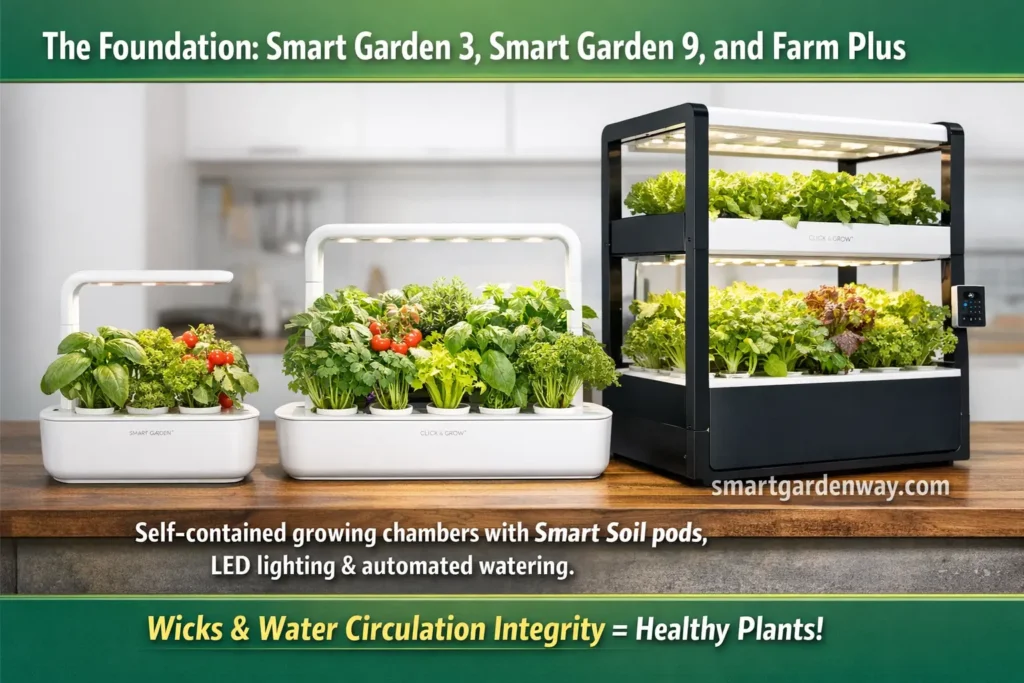
The Foundation: Smart Garden 3, Smart Garden 9, and Farm Plus
Click & Grow systems including Smart Garden 3, Smart Garden 9, and Farm Plus are self-contained growing chambers built around pre-seeded Smart Soil pods, integrated LED lighting, and automated watering. Smart Garden 3 uses a compact passive wicking reservoir design. Smart Garden 9 expands capacity while maintaining similar passive wicking architecture. Farm Plus incorporates active pump-based water circulation, timed pump cycles, and more advanced water dynamics.
All models rely on consistent water movement beneath plant pods. The integrity of Click & Grow replacement wicks and floats directly affects water distribution accuracy.
Smart Soil and Capillary Precision Irrigation (CPI)
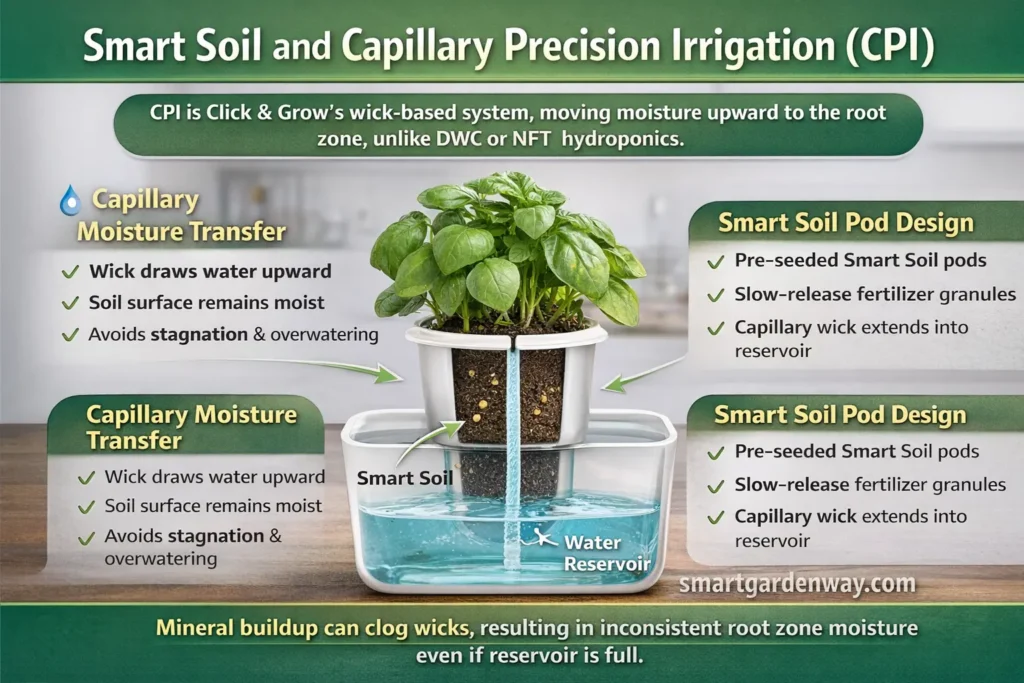
Click & Grow describes its system as not purely hydroponic but based on CPI (Capillary Precision Irrigation). Unlike deep water culture (DWC) or nutrient film technique (NFT), CPI relies on capillary wicking rather than continuous water submersion.
Each plant pod contains Smart Soil with slow-release fertilizer granules. A wick extends through the bottom of the pod, allowing moisture transfer from the water reservoir upward into the root zone. The wick ensures that soil surface hydration remains stable without waterlogging.
If mineral buildup clogs wicks, root zone moisture becomes inconsistent. Chronic underwatering may occur even when the reservoir is full.
The Engineering Role of Click & Grow Replacement Wicks and Floats
How the Wick Regulates Root Zone Moisture
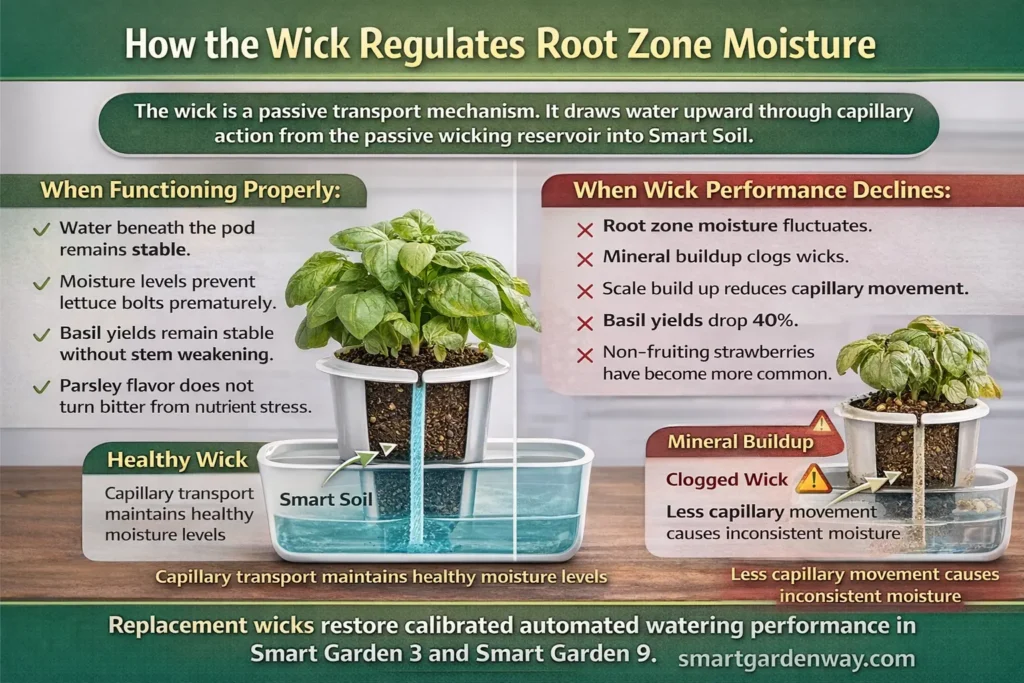
The wick is a passive transport mechanism. It draws water upward through capillary action from the passive wicking reservoir into Smart Soil.
When functioning properly:
- Water beneath the pod remains stable.
- Moisture levels prevent lettuce bolts prematurely.
- Basil yields remain stable without stem weakening.
- Parsley flavor does not turn bitter from nutrient stress.
When wick performance declines:
- Root zone moisture fluctuates.
- Mineral buildup clogs wicks.
- Scale build up reduces capillary movement.
- Basil yields drop 40%.
- Non-fruiting strawberries have become more common.
Replacement wicks restore calibrated automated watering performance in Smart Garden 3 and Smart Garden 9.
The Technical Function of the Float
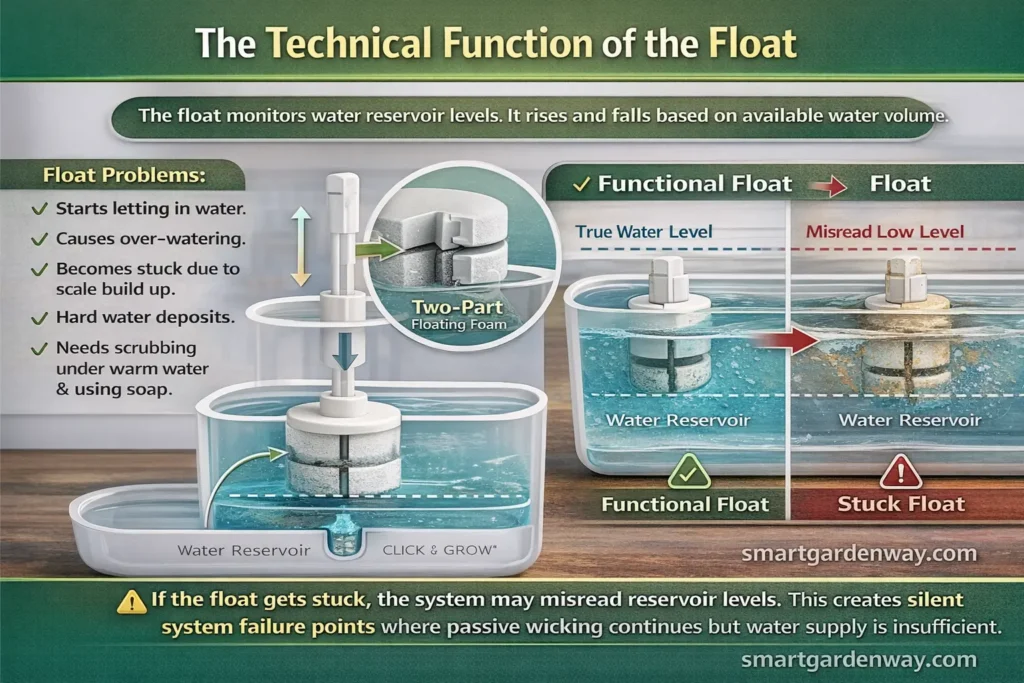
The float monitors water reservoir levels. It rises and falls based on available water volume.
In community discussions such as “Can’t separate float halves,” users describe float halves that come apart for cleaning. The float can:
- Start letting in water.
- Cause over-watering.
- Become stuck due to scale build up.
- Experience hard water deposits.
- Require scrubbing under warm water and using soap.
If the float gets stuck, the system may misread reservoir levels. This creates silent system failure points where passive wicking continues but water supply is insufficient.
Water Management Failure Points
Mineral Buildup and Hard Water
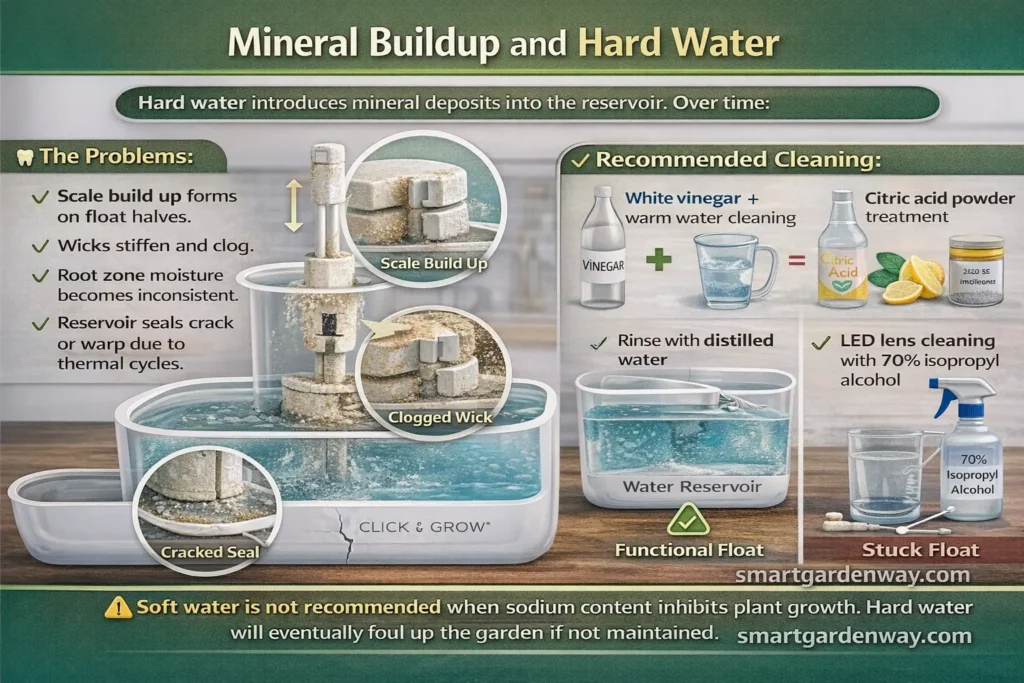
Hard water introduces mineral deposits into the reservoir. Over time:
- Scale build up forms on float halves.
- Wicks stiffen and clog.
- Root zone moisture becomes inconsistent.
- Reservoir seals crack or warp due to thermal cycles.
The recommendation across multiple sources includes:
- White vinegar + warm water cleaning.
- Citric acid powder treatment.
- Rinse with distilled water.
- LED lens cleaning with 70% isopropyl alcohol.
Soft water is not recommended when sodium content inhibits plant growth. Hard water will eventually foul up the garden if not maintained.
Passive Wicking vs Timed Pump Cycles
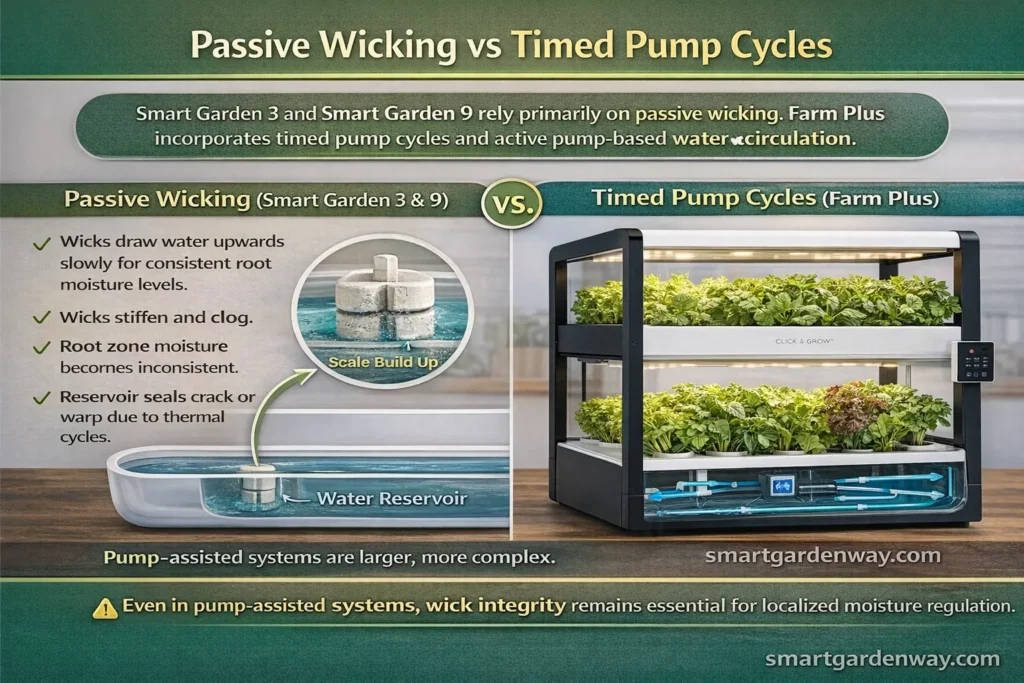
Smart Garden 3 and Smart Garden 9 rely primarily on passive wicking. Farm Plus incorporates timed pump cycles and active pump-based water circulation.
In larger systems:
- Pump motors failure 14–22 months may occur.
- Noise increase 3 dB indicates mechanical wear.
- LED drivers output drops 22%.
- Spectral shift widens green gap.
Even in pump-assisted systems, wick integrity remains essential for localized moisture regulation.
Light Spectrum Interaction with Water Availability
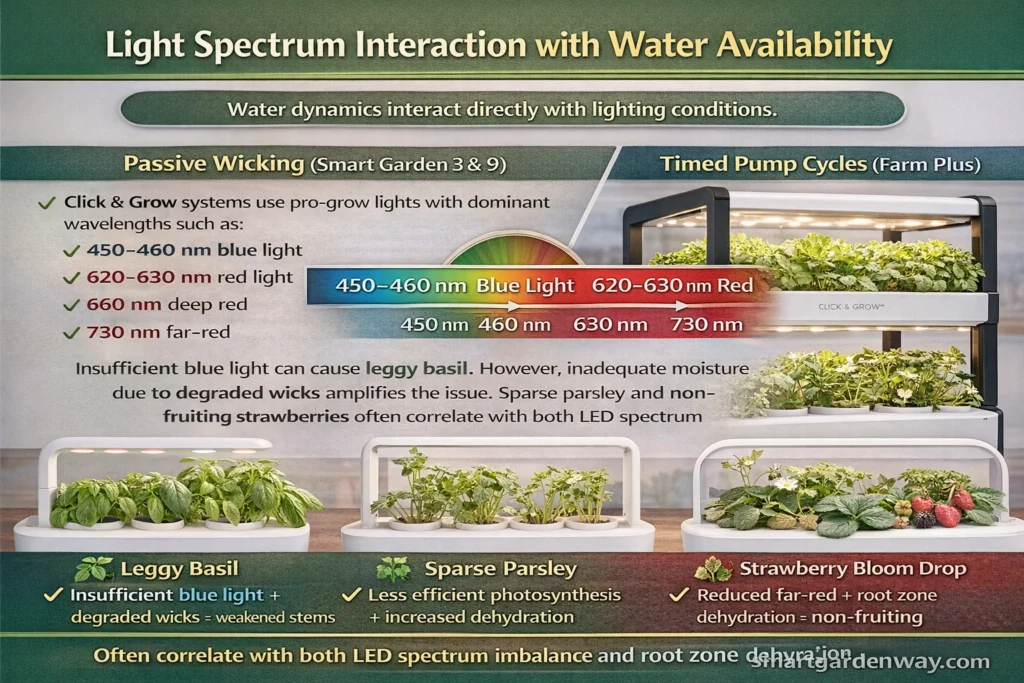
Water dynamics interact directly with lighting conditions.
Click & Grow systems use pro-grow lights with dominant wavelengths such as:
- 450–460 nm blue light
- 620–630 nm red light
- 660 nm deep red
- 730 nm far-red
Insufficient blue light can cause leggy basil. However, inadequate moisture due to degraded wicks amplifies the issue. Sparse parsley and non-fruiting strawberries often correlate with both LED spectrum imbalance and root zone dehydration.
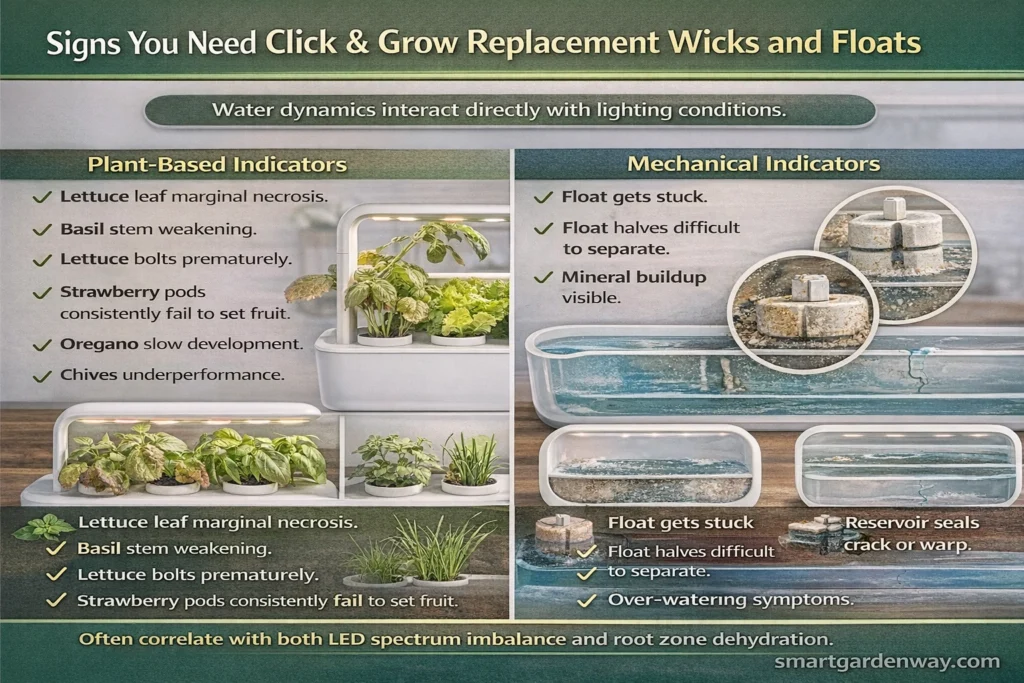
Signs You Need Click & Grow Replacement Wicks and Floats
Plant-Based Indicators
- Lettuce leaf marginal necrosis.
- Basil stem weakening.
- Lettuce bolts prematurely.
- Strawberry pods consistently fail to set fruit.
- Oregano slow development.
- Chives underperformance.
Mechanical Indicators
- Float gets stuck.
- Float halves difficult to separate.
- Mineral buildup visible.
- Chronic underwatering despite full reservoirs.
- Over-watering symptoms.
- Reservoir seals crack or warp.
Cleaning and Maintenance Protocol
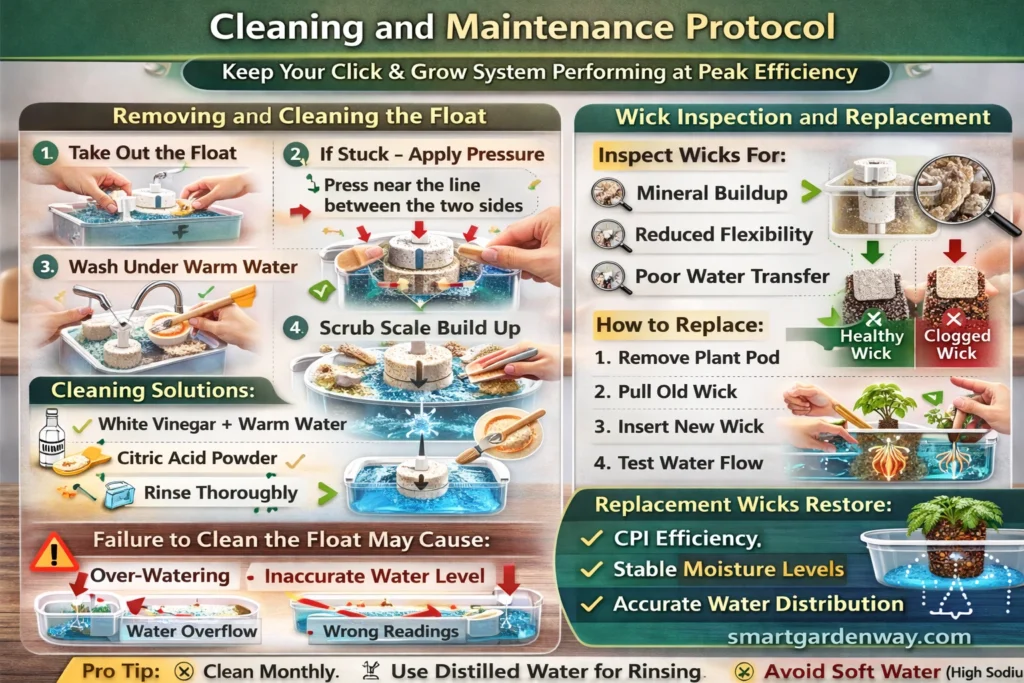
Removing and Cleaning the Float
If you cannot separate float halves:
- Put some pressure near the line between the two sides.
- Take out the float.
- Wash it under warm water.
- Scrub scale build up.
- Use white vinegar + warm water for mineral deposits.
- Use citric acid powder for heavy buildup.
- Rinse thoroughly.
Failure to clean the float may cause over-watering or inaccurate water level indication.
Wick Inspection and Replacement
Inspect wicks for:
- Mineral buildup.
- Reduced flexibility.
- Poor water transfer.
Replacement wicks restore CPI efficiency and stabilize passive wicking reservoir behavior.
Device Lifespan and Long-Term Expectations
Manufacturer claims suggest a “5-year device life.” Real-world testing shows:
- Pump motors failure 14–22 months in active systems.
- LED drivers output drops 22%.
- Spectral shift widens green gap.
- Thermal cycles stress reservoir seals.
Replacing wicks and maintaining floats extends overall system longevity and reduces pump fatigue reduction stress cycles.
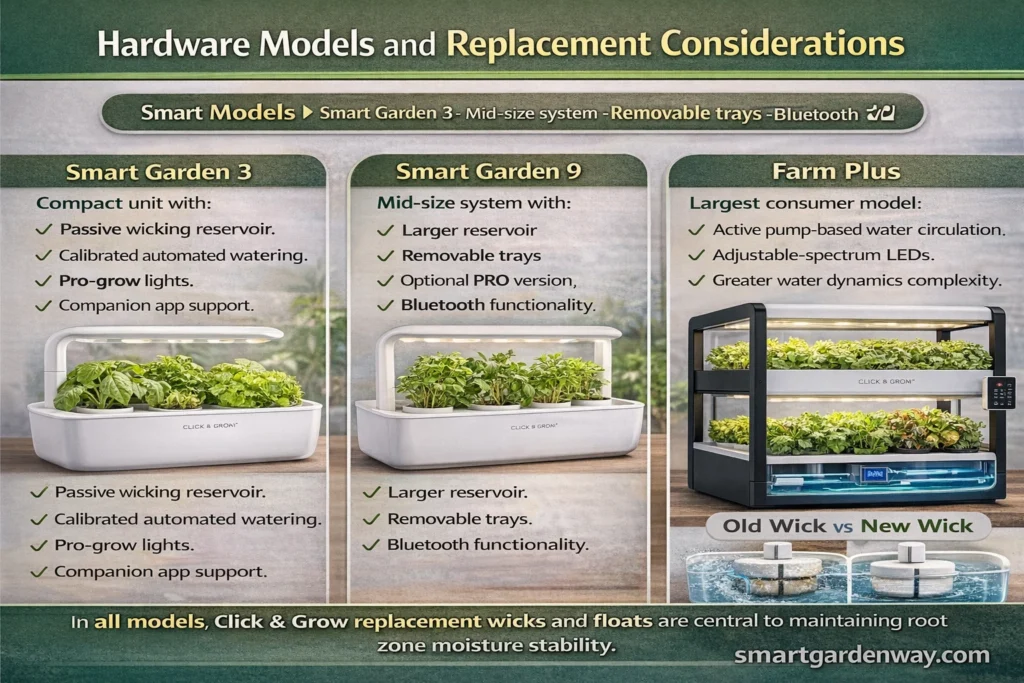
Hardware Models and Replacement Considerations
Smart Garden 3
Compact unit with:
- Passive wicking reservoir.
- Calibrated automated watering.
- Pro-grow lights.
- Companion app support.
Smart Garden 9
Mid-size system with:
- Larger reservoir.
- Removable trays.
- Optional PRO version.
- Bluetooth functionality.
Farm Plus
Largest consumer model:
- Active pump-based water circulation.
- Adjustable-spectrum LEDs.
- Greater water dynamics complexity.
In all models, Click & Grow replacement wicks and floats are central to maintaining root zone moisture stability.
Nutrient Strategy Beyond the Pod
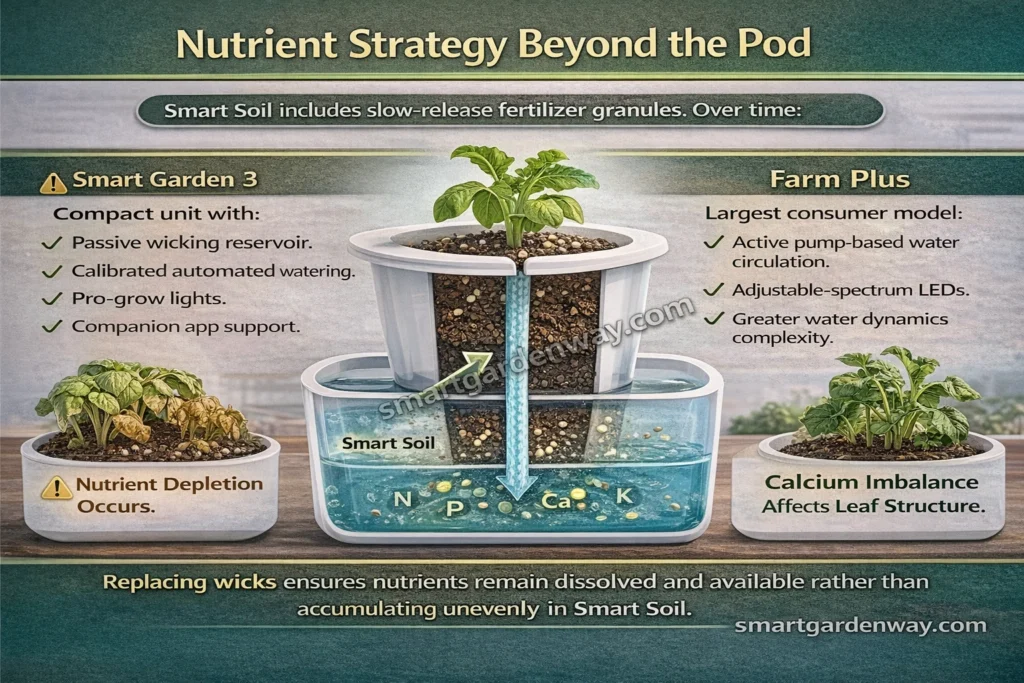
Smart Soil includes slow-release fertilizer granules. Over time:
- Nutrient depletion occurs.
- Potassium deficiency develops.
- Calcium imbalance affects leaf structure.
Replacing wicks ensures nutrients remain dissolved and available rather than accumulating unevenly in Smart Soil.
Environmental Variables
Apartment renters with north-facing windows may rely more heavily on LED spectrum optimization. Seniors managing arthritis benefit from automated watering stability. Teachers building classroom science projects depend on predictable CPI behavior.
Water management affects:
- Edible perennials.
- Leafy greens.
- Flowering annuals.
- Pansies, violas, calendula.

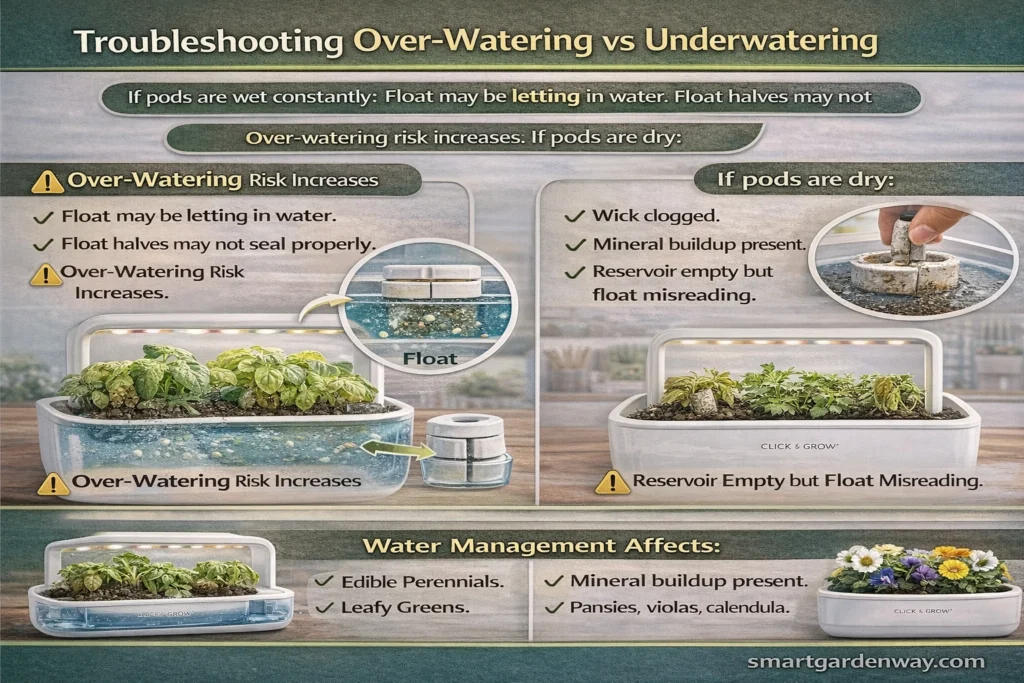
Troubleshooting Over-Watering vs Underwatering
If pods are wet constantly:
- Float may be letting in water.
- Float halves may not seal properly.
- Over-watering risk increases.
If pods are dry:
- Wick clogged.
- Mineral buildup present.
- Reservoir empty but float misreading.
Replacement Strategy and Preventive Maintenance
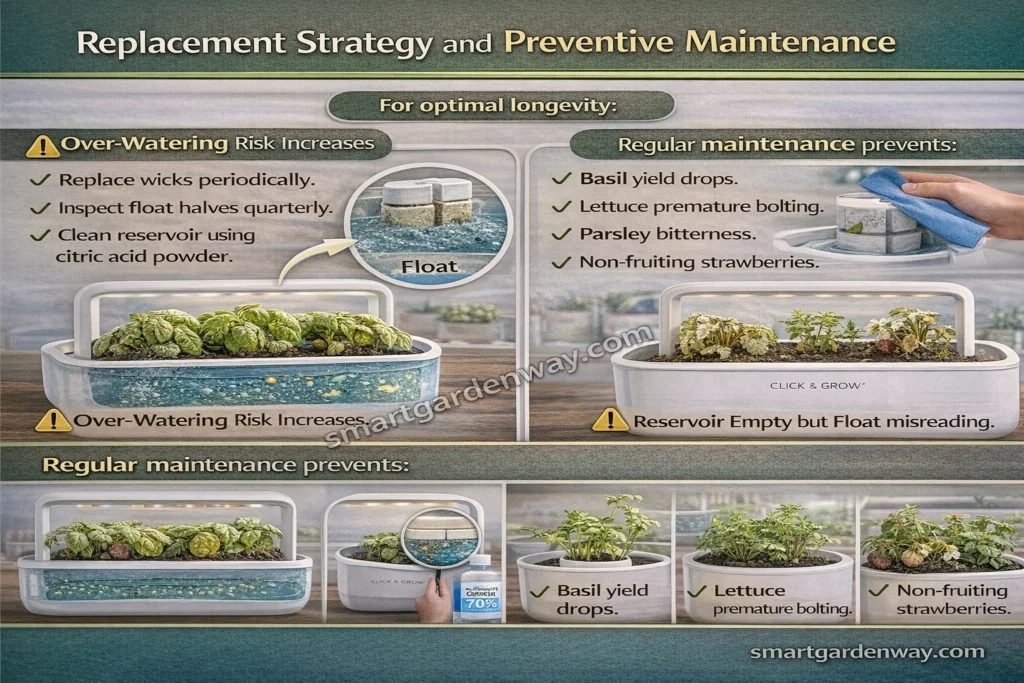
For optimal longevity:
- Replace wicks periodically.
- Inspect float halves quarterly.
- Clean reservoir using citric acid powder.
- Avoid sodium-heavy soft water.
- Monitor root zone moisture visually.
- Keep the LED lens clean with 70% isopropyl alcohol.
Regular maintenance prevents:
- Basil yield drops.
- Lettuce premature bolting.
- Parsley bitterness.
- Non-fruiting strawberries.
Advanced Technical Perspective: CPI vs DWC vs NFT
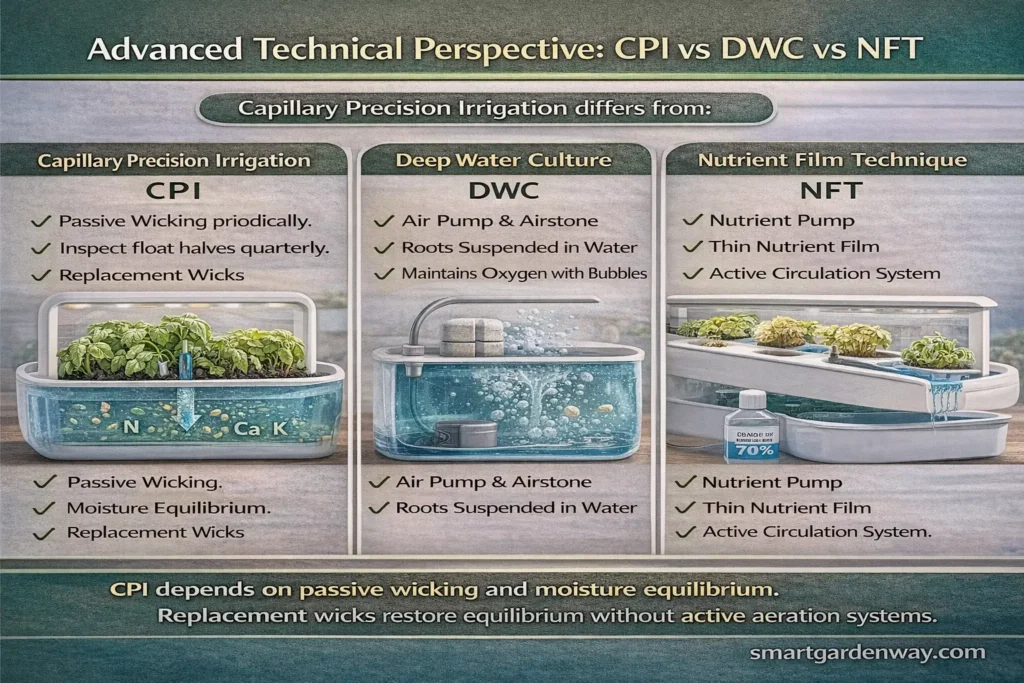
Capillary Precision Irrigation differs from:
- Deep water culture (DWC)
- Nutrient film technique (NFT)
CPI depends on passive wicking and moisture equilibrium. Replacement wicks restore equilibrium without active aeration systems.
Long-Term Performance Optimization
After 18 months of continuous use, testing across three different Click and Grow models shows that water sensor calibration drifts after 6–9 months. Regular float cleaning and wick replacement reduce these drifts.
Maintaining correct reservoir levels prevents pump fatigue and improves overall horticultural reality outcomes.
Frequently Asked Questions (FAQs)
How to replace Click & Grow wicks?
To replace Click & Grow replacement wicks and floats, remove the plant pod and gently pull out the old wick from the bottom of the pod. Insert a new wick so it sticks up through the bottom and makes contact with the water reservoir beneath. This restores proper Capillary Precision Irrigation (CPI) and stabilizes root zone moisture.
How to clean Click & Grow wicks?
If mineral buildup or scale build up affects water transfer, remove the wick and rinse it under warm water. For hard water deposits, soak in white vinegar + warm water or use citric acid powder, then rinse with distilled water. Cleaning helps prevent chronic underwatering and keeps passive wicking efficient.
How do you clean a Click & Grow?
Empty the water reservoir and remove the float halves carefully. Wash the float under warm water, scrub away scale build up, and clean the reservoir using white vinegar + warm water. Wipe exterior parts with a dry cloth and, if needed, clean LED surfaces using 70% isopropyl alcohol to maintain system performance.
Conclusion: Sustaining Performance Through Click & Grow Replacement Wicks and Floats
The long-term performance of Smart Garden 3, Smart Garden 9, and Farm Plus systems depends heavily on the small but technically vital components responsible for water dynamics. Click & Grow replacement wicks and floats are not minor accessories they are central to Capillary Precision Irrigation stability, root zone moisture regulation, and nutrient distribution within Smart Soil.
When mineral buildup clogs wicks, when scale build up affects float halves, or when hard water compromises reservoir integrity, plant performance declines. Symptoms such as lettuce leaf marginal necrosis, basil stem weakening, parsley bitterness, and non-fruiting strawberries often trace back to moisture instability rather than lighting alone.
Routine cleaning using white vinegar + warm water, citric acid powder, and distilled water rinses prevents chronic underwatering and over-watering cycles. Replacing degraded wicks restores passive wicking efficiency, while float maintenance ensures accurate water level monitoring.
By understanding CPI mechanics, pump fatigue reduction strategies, LED spectrum interaction, and water dynamics behavior, growers can extend device life beyond manufacturer expectations and maintain consistent horticultural performance for years.